Activities
Schedule#
THERE HAS BEEN A SCHEDULE CHANGED! SEE BELOW.
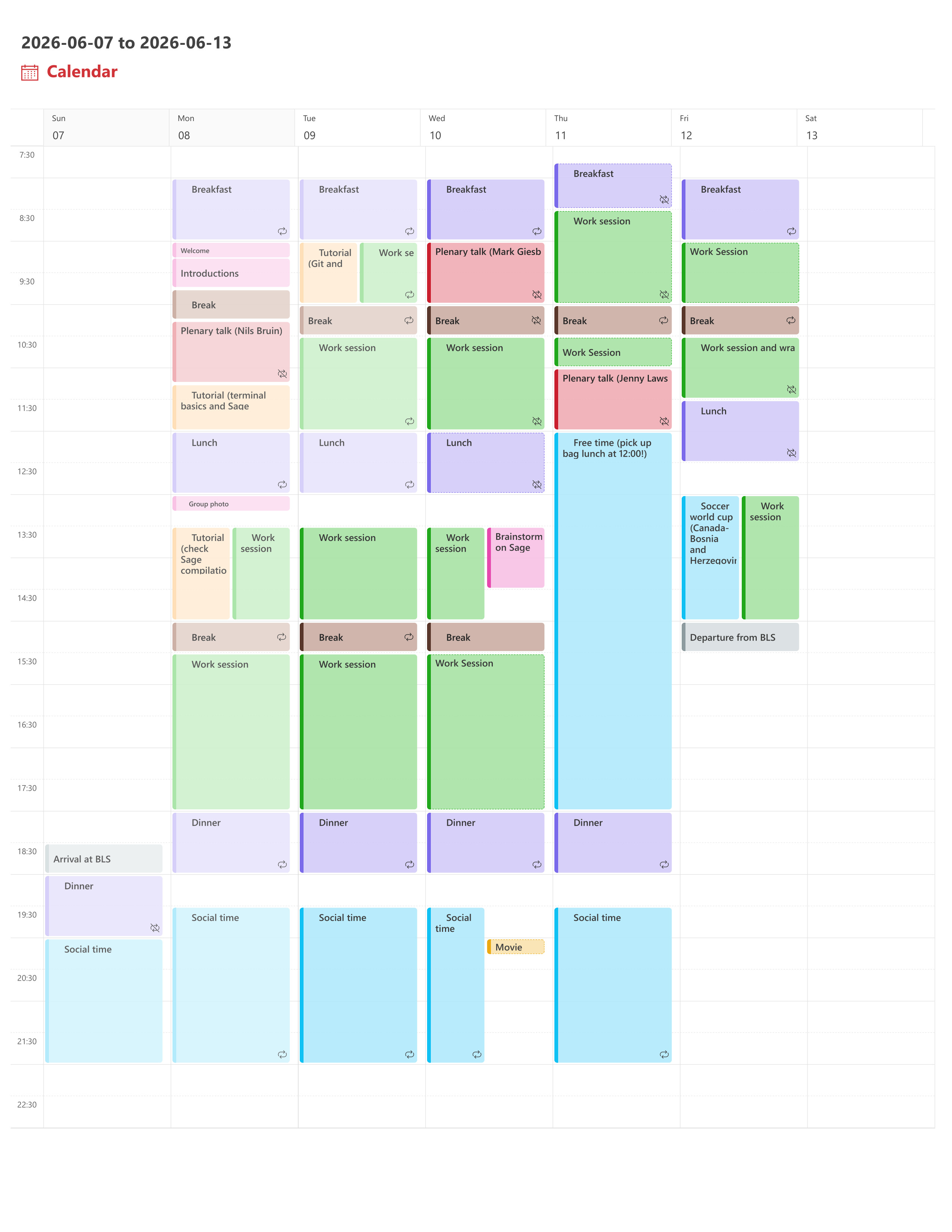
Here are a PDF version and a list version (PDF).
Plenary talks#
Nils Bruin (Simon Fraser University)#
Developing a software package within a computer algebra system
Abstract: When writing software to perform advanced mathematical computations one generally needs to rely on preexisting libraries. Developing the software within a computer algebra is then often the most attractive option. To maximize the utility of the software, one should then ensure the newly developed routines integrate well with the existing ones. There are choices to make whether to package the software separately or aim for integration into the larger package directly.
As a case study, we will look at the development of the period matrix functionality for algebraic Riemann surfaces in SageMath (see here), as well as a closely related package for computing Riemann Theta functions (see here). We review the design considerations and decisions made for these packages in view of the different stages in their development history and leave it to the audience if they want to take it as a shiny example or a cautionary tale.
In addition, we will showcase the functionality of the packages to serve as an illustration of the utility of putting the extra effort into mathematical software to make it useful beyond the original narrow application.
Nils Bruin is a professor in the Department of Mathematics at Simon Fraser University. His research interests include number theory (especially algorithmic and computational), algebraic & arithmetic geometry and computer algebra, focusing on rational points on varieties, particularly curves and Abelian varieties. Following his MSc in 1995 and his PhD in 1999 in Mathematics from Leiden University in the Netherlands, Nils was an NWO researcher at Utrecht University in hte Netherlands, a postdoc at MSRI (now LSMath) in Berkeley, a PIMS PDF at Simon Fraser University and the University of British Columbia, and a Senior Research Associate with the MAGMA Group at the University of Sydney in Australia. In 2003, he joined the Faculty at Simon Fraser. Nils has authored and co-authored some 45 research articles and supervised 15 graduate theses.
Mark Giesbrecht (University of Waterloo)#
Sparse Exact Linear Algebra: Theory, Algorithms, and Implementation
Exact linear algebra over integers, finite fields, and related exact domains have a rich interaction between asymptotic complexity and practical implementation. This talk will explore the transition from dense algorithms whose costs are governed by cubic exponents and matrix multiplication, to sparse and black-box methods based on block Wiedemann’s techniques and linear recurring sequences. We’ll pay particular attention to subcubic algorithms for sparse exact linear algebra, including Otilde(n^2.5) integer/rational solving and recent faster-than-matrix-multiplication methods for Smith form.
We’ll also discuss how these algorithmic ideas are (and might be) realized in software, including LinBox and Sage. The emphasis is on the feedback between theory and implementation: black-box abstractions, blocking, preconditioning, modular computation, lifting, and certification provide both the foundation for improved complexity bounds and the architecture for effective exact linear algebra software.
Mark Giesbrecht is a Professor in the David R. Cheriton School of Computer Science at the University of Waterloo, conducting research in symbolic computation and computer algebra, especially as applied to algebra and number theory. He received his MSc in 1988 and his PhD in 1993 in Computer Science from the University of Toronto. After working as a compiler researcher and developer for IBM Canada and holding faculty positions at the University of Manitoba and the University of Western Ontario, Mark joined the University of Waterloo in 2001. He served as Director of Undergraduate Studies and subsequently Director of the School of Computer Science, and was until recently the Dean of the Faculty of Mathematics at the University of Waterloo (yes, UW has a Faculty of Math!). Mark has written well over 80 research articles and supervised some 34 graduate students and postdocs. In 2004, Mark received an NSERC Synergy Award for Innovation for his work with Maplesoft, and was named an ACM Distinguished Scientist in 2013 for his contributions to Maple and LinBox, the foremost software package for exact computational linear algebra.
Jenny Lawson (University of Calgary)#
Why SageMath?
Every few years, educators are bombarded with marketing that goes something like, “Transform teaching and learning in your classroom by using [insert new fancy technology here]!” If you’ve been in educational spaces for any length of time, you will have seen many such technologies come and go. Unfortunately, many of these technologies don’t end up truly transforming the teaching and learning that goes on in classrooms. Why is that? Is it because they never had the potential? Or is it because their potential was never truly harnessed? A technology like SageMath could completely change the way we teach and learn, but only if we figure out how to use it the right way. That’s where digital pedagogy comes in. Digital pedagogy is the study and practice of using digital tools to enhance and transform teaching and learning. In this interactive talk, we will explore the potential of SageMath in the classroom from the lens of digital pedagogy by starting from the most important question: why SageMath?
Jenny Lawson is an interdisciplinary PhD Candidate studying Mathematics & Educational Research at the University of Calgary. She completed her BSc in Mathematical Science with an area of emphasis in computer science at the University of Guelph in 2020, followed by an MSc in Mathematics in 2022 at the University of Calgary (PhD hopefully to come in 2026). Her current research falls anywhere between applied mathematical research with a heavy numerical and computational analysis focus, to qualitative work research on teaching and learning in undergraduate classrooms. She has taught several courses as a sessional instructor at the University of Calgary where she loved using educational technologies to enhance her teaching and has received lots of positive feedback.
Work organization#
A few key points:
- Participants are welcome to work at their own pace and extent set their own schedule, although meal times are fixed.
- Some days will begin or end with plenary talks or wrap-up sessions that all participants should attend.
- Throughout the day there may be labs and tutorials about specific topics that will only interest and be attended by participants who wish to learn about that topic.
- Participants are encouraged to make the most out of their visit: this can mean discussing Sage on a hike in the mountains, late-night karaoke, etc.
Scientific content and organization#
Although the organizers are number theorists, we welcome participants from all areas of mathematics who are interested in Sage.
Invited speakers#
We will have plenary talks from:
- Nils Bruin (Simon Fraser University)
- Mark Giesbrecht (University of Waterloo)
- Jenny Lawson (University of Calgary)
Titles and abstracts will be posted on the website soon.
Labs and tutorials#
We will also have labs and tutorials aimed at beginners, including:
- Basics of the terminal.
- Basics of git and GitHub.
- Getting your code into Sage.
If you want a particular topic to be discussed, please ask us in the application form.
Contributions to Sage#
We will strongly encourage (first) contributions to SageMath.